De vier dochters Bennet


De vier dochters Bennet (The Four Bennet Daughters) is a Dutch adaptation of Pride and Prejudice that was originally televised in the Netherlands from 1961-1962. It's a six-part miniseries, and each episode is about 45 minutes long. The entire series is available with subtitles on YouTube.

What's different


You may have noticed that this adaptation is called The Four Bennet Daughters, not the five. Poor Kitty is gone, and Mary has assumed many of her lines and personality traits. It's a bit weird to see Mary annoying everyone with her harpsichord playing one minute and traipsing after Lydia the next, but this adaptation is otherwise very faithful to the book. Pretty much every major plot point and event is included, and the story progresses at just a slightly quicker pace.

Of the changes that are present, many are just different ways of conveying the same information. For example, this adaptation is very against letters for some reason. Almost everything that was conveyed by a letter in the book is acted out in this miniseries. Caroline tells Jane to her face that Charles is hot for Georgiana; we witness Caroline visiting Jane and being super fucking rude in London; and there is no post-proposal letter from Darcy.

"CHARLES IS TAKEN! I REPEAT, CHARLES IS TAKEN!"

Pride and Prejudice (1940)


This black and white MGM film stars Greer Garson as Elizabeth and Laurence Olivier as Darcy. It was directed by Robert Z. Leonard and written by Aldous Huxley (yes, that Aldous Huxley) and Jane Murfin. It was adapted from a stage play by Helen Jerome. This is the earliest surviving film adaptation of Pride and Prejudice that I could find; an earlier BBC adaptation directed by Campbell Logan is believed to be lost.

What's different


QUITE a bit. Since this is the earliest existing screen adaptation, I expected it to follow the book closely. Then again, it is a movie based on a play based on a book, so plenty was probably lost in translation. Some of it can be chalked up needing a shorter timeline. For example, Wickham has already arrived in Meryton when the movie opens, and Lizzy's entire vacation with the Gardiners (including the visit to Pemberley) is omitted. Some of these for-the-sake-of-time changes are more forgivable than others.

Several scenes from the book are smushed together haphazardly, presumably still in the interest of saving time. At the Meryton ball, where Darcy first gets a reputation as a snob, he asks Lizzy to dance very soon after she overhears him insulting her, and she turns him down. In the book, this happens at a party held later at Lucas Lodge, after Darcy has started to crush on her a little. This means that in this movie, Darcy goes from dissing Lizzy to asking her to dance in a matter of minutes, which is way too fast.

"How is this possible? It surely can't be because I spent the last ten minutes insulting you, your family, and your entire way of life."

Pride and Prejudice: The Book


Of course I've read this one before. Like Sense and Sensibility, I read Pride and Prejudice first in high school, but I think I may have reread it at some point in college. I've seen several adaptations, including the 1995 and 2005 versions. Those two are the ones I'm most dreading reviewing because Austen fans tend to choose sides. I have two close friends who are on opposing sides of the 1995 v. 2005 debate, so I'm sure to offend someone at some point!

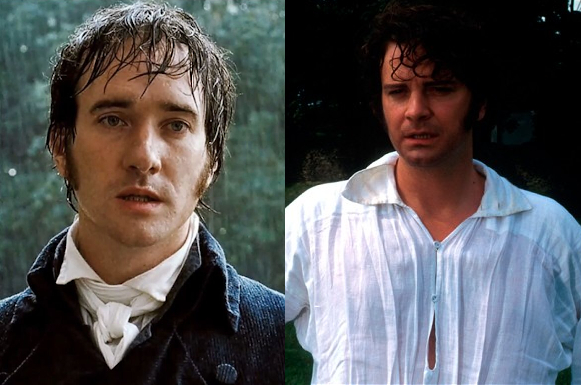
There can be only one.

My main impression after this reread was that Pride and Prejudice is not as funny as Sense and Sensibility. There is humor, for sure, just not as much and it's not as in your face. Because of this, I wouldn't mind a P&P adaptation that is all drama and no comedy. I noticed plenty of scenes in the book that could be played up very comically, and if any adaptations decided to do that, they had better do a good job of it. It could easily become obnoxious. An adaptation that achieves a perfect balance of humor and drama would really amaze me; I think Austen herself falls on the side of more drama than comedy, at least from the perspective of a modern reader, so finding that balance would be a real coup.

Sense and Sensibility: The Final Score

One novel down! I watched 10 Sense and Sensibility adaptations over the last three months:


It was easier than I expected to watch so many adaptations of the same work. There's a lot of variety in the bunch, both in the way the story is told and in the quality of the telling. Even watching four straight adaptations wasn't that bad because I enjoyo nitpicking the details. 

Now it's time to move on to Pride and Prejudice, which has been adapted to film more than 30 times. But before I leave Sense and Sensibility behind, I want to hand out some awards.


Bitchiest Adaptation

Sense, Sensibility & Snowmen


It's Christmastime in modern-day Chicago, and sisters Ella (Erin Krakow) and Marianne Dashwood (Kimberley Sustad) are busy running their event planning business together. Ella, the free spirit who is trying to prove that she's ready to commit to the family business, wants to grow their business but faces opposition from Marianne, who is content with the status quo. To prove herself, Ella takes on a last minute Christmas party for toy company executive and fun-hater Edward Ferris (Luke Macfarlane). While sparks fly between Ella and Edward, Marianne is busy flirting awkwardly with the equally awkward Brandon Williams (Jason McKinnon), who is for some reason both Edward's cousin AND the Dashwoods' lawyer.

And there are intensely cozy Christmas vibes throughout.

What's different

Some interesting choices were made for this movie, which is all it takes to get me excited at this point. Marianne and Elinor (Ella) seem to have traded personalities. In adaptation shorthand, Elinor = mature and Marianne = childish. In this movie, however, Marianne is down-to-earth and organized, and Ella is an irresponsible commitment-phobe and hopeless romantic. It feels like the sisters' names were assigned to the characters at random, and they didn't land right.