You've Got Mail


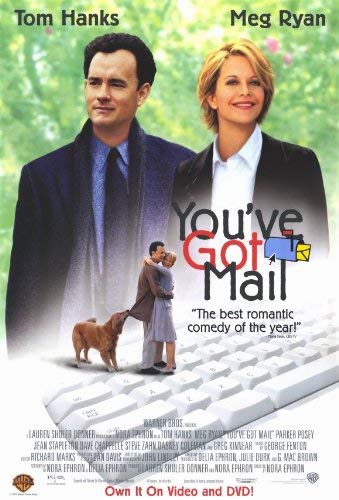
"Struggling boutique bookseller Kathleen Kelly (Meg Ryan) hates Joe Fox (Tom Hanks), the owner of a corporate Foxbooks chain store that just moved in across the street. When they meet online, however, they begin an intense and anonymous Internet romance, oblivious of each other's true identity. Eventually Joe learns that the enchanting woman he's involved with is actually his business rival. He must now struggle to reconcile his real-life dislike for her with the cyber love he's come to feel."

What's different


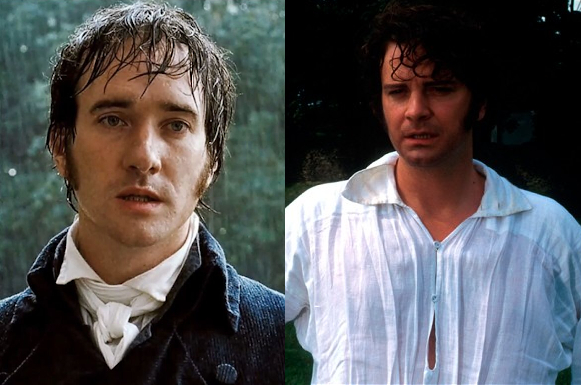
This classic 90s rom-com can't rightly be called a Pride and Prejudice adaptation, but it openly encourages viewers to draw comparisons between the two love stories. P&P is Kathleen's favorite book; Joe struggles to get through it. It's the book Kathleen takes to the cafe to meet Joe (before she knows it's Joe), paired with a red rose so he'll know it's her. And Joe compares Kathleen to Elizabeth when he accuses her of being too proud to forgive him.

Joe clearly agrees with me on the pointless pride/prejudice dichotomy.

How similar is Joe and Kathleen's relationship to Darcy and Elizabeth's? The basic structure of the two relationships are the same: girl meets boy, girl hates boy, boy likes girl, girl rejects boy, girl realizes boy isn't so bad after all, girl starts to like boy, girl and boy end up together. But the similarities don't continue very far from there. There's also one glaring opposite in their stories: Darcy saves Elizabeth, in a way, by saving her family from disgrace; Joe, on the other hand, hurts Kathleen by literally putting her out of business. Not a very Darcy move.

Wishbone: Furst Impressions


An under-thirty-minute Pride and Prejudice adaptation in which Mr. Darcy is played by a dog? Oh yeah, I'm in.

The three human protagonists of Wishbone are Joe (Wishbone's owner) and his friends Sam and David. In this episode, Joe feels uncool after a bully insults his clothes; Sam and David fight with each other over rumors about who asked who to the dance; and Joe, caught in the middle of the fighting, struggles to restore the peace. Wishbone teaches the viewers at home that it's okay to be nervous about social situations, you shouldn't listen to rumors, and sometimes communication is hard. He demonstrates these points by entering the story of Pride and Prejudice, "a juicy, meaty book about people and parties."

What's different


First and foremost, Mr. Darcy is played by a dog named Wishbone. And honestly, I'm here for it.

Look out, Colin Firth, you've got competition.

Pride and Prejudice (1995)


I'm not writing a synopsis for this one. You know what this is.

What's different


Not much, really. This adaptation follows the book very closely. There were only a few differences that really stuck out to me. Firstly and most importantly, this version has a secondary theme that was not even hinted at in the book, and that is Mr. Darcy being wet. He gets wet constantly! To start, we see him taking a bath and then watching Lizzie play in the yard. And while he did put on a robe before going to the window, I would like to point out that the robe was clearly hanging open in the front. Later on, we see Darcy all hot and sweaty from fencing practice, which is a very in-your-face metaphor for his internal battle against his emotions. And finally, we have the famous pond scene. And by the way, that pond is NASTY.

"Oh damn, I haven't been wet in over 30 minutes. Better jump in this disgusting pond!" — Darcy, probably

I can't believe they passed up the opportunity for him to take yet another bath because he would clearly need one after diving into pond scum. Regardless of his hygiene, though, one is forced to conclude that the overarching theme of this miniseries is Darcy being wet.

But who's complaining?

Pride and Prejudice (1980)


The 1980 BBC miniseries adaptation of Pride and Prejudice was adapted by Fay Wheldon and directed by Cyril Coke. It stars Elizabeth Garvie as Elizabeth Bennet and David Rintoul as Fitzwilliam Darcy. It was the fifth BBC adaptation of Pride and Prejudice, but it's the earliest one that survives in its entirety.

What's different


This is a fairly accurate adaptation, and I can tell it laid a lot of the groundwork for the BBC's more successful attempt in 1995. There are some added scenes that aren't in the book, to make this version unique. The most striking difference, though, is the seemingly arbitrary rearranging of particular lines from the book. A few examples: Charlotte's line about happiness in marriage is like the third line of the show, spoken before the Bingleys ever arrive at Netherfield; the line to Mary about having "delighted us long enough" comes from Mrs. Bennet, not Mr., and is spoken at a different party; and Elizabeth's observation that "young men must have something to live on" comes from Mary now.

It feels very odd to hear Mary say anything reasonable. Thankfully, she doesn't do it much.

Actually, Mary gets a lot more attention in this miniseries than she has any right to. She's the Bennet daughter most likely to be cut from any adaptation, but this one goes completely in the other direction by ramping up her part. She speaks and is spoken to quite often, sometimes poaching other characters' lines and sometimes making entirely new pronouncements.

De vier dochters Bennet


De vier dochters Bennet (The Four Bennet Daughters) is a Dutch adaptation of Pride and Prejudice that was originally televised in the Netherlands from 1961-1962. It's a six-part miniseries, and each episode is about 45 minutes long. The entire series is available with subtitles on YouTube.

What's different


You may have noticed that this adaptation is called The Four Bennet Daughters, not the five. Poor Kitty is gone, and Mary has assumed many of her lines and personality traits. It's a bit weird to see Mary annoying everyone with her harpsichord playing one minute and traipsing after Lydia the next, but this adaptation is otherwise very faithful to the book. Pretty much every major plot point and event is included, and the story progresses at just a slightly quicker pace.

Of the changes that are present, many are just different ways of conveying the same information. For example, this adaptation is very against letters for some reason. Almost everything that was conveyed by a letter in the book is acted out in this miniseries. Caroline tells Jane to her face that Charles is hot for Georgiana; we witness Caroline visiting Jane and being super fucking rude in London; and there is no post-proposal letter from Darcy.

"CHARLES IS TAKEN! I REPEAT, CHARLES IS TAKEN!"

Pride and Prejudice (1940)


This black and white MGM film stars Greer Garson as Elizabeth and Laurence Olivier as Darcy. It was directed by Robert Z. Leonard and written by Aldous Huxley (yes, that Aldous Huxley) and Jane Murfin. It was adapted from a stage play by Helen Jerome. This is the earliest surviving film adaptation of Pride and Prejudice that I could find; an earlier BBC adaptation directed by Campbell Logan is believed to be lost.

What's different


QUITE a bit. Since this is the earliest existing screen adaptation, I expected it to follow the book closely. Then again, it is a movie based on a play based on a book, so plenty was probably lost in translation. Some of it can be chalked up needing a shorter timeline. For example, Wickham has already arrived in Meryton when the movie opens, and Lizzy's entire vacation with the Gardiners (including the visit to Pemberley) is omitted. Some of these for-the-sake-of-time changes are more forgivable than others.

Several scenes from the book are smushed together haphazardly, presumably still in the interest of saving time. At the Meryton ball, where Darcy first gets a reputation as a snob, he asks Lizzy to dance very soon after she overhears him insulting her, and she turns him down. In the book, this happens at a party held later at Lucas Lodge, after Darcy has started to crush on her a little. This means that in this movie, Darcy goes from dissing Lizzy to asking her to dance in a matter of minutes, which is way too fast.

"How is this possible? It surely can't be because I spent the last ten minutes insulting you, your family, and your entire way of life."

Pride and Prejudice: The Book


Of course I've read this one before. Like Sense and Sensibility, I read Pride and Prejudice first in high school, but I think I may have reread it at some point in college. I've seen several adaptations, including the 1995 and 2005 versions. Those two are the ones I'm most dreading reviewing because Austen fans tend to choose sides. I have two close friends who are on opposing sides of the 1995 v. 2005 debate, so I'm sure to offend someone at some point!

There can be only one.

My main impression after this reread was that Pride and Prejudice is not as funny as Sense and Sensibility. There is humor, for sure, just not as much and it's not as in your face. Because of this, I wouldn't mind a P&P adaptation that is all drama and no comedy. I noticed plenty of scenes in the book that could be played up very comically, and if any adaptations decided to do that, they had better do a good job of it. It could easily become obnoxious. An adaptation that achieves a perfect balance of humor and drama would really amaze me; I think Austen herself falls on the side of more drama than comedy, at least from the perspective of a modern reader, so finding that balance would be a real coup.

Sense and Sensibility: The Final Score

One novel down! I watched 10 Sense and Sensibility adaptations over the last three months:


It was easier than I expected to watch so many adaptations of the same work. There's a lot of variety in the bunch, both in the way the story is told and in the quality of the telling. Even watching four straight adaptations wasn't that bad because I enjoyo nitpicking the details. 

Now it's time to move on to Pride and Prejudice, which has been adapted to film more than 30 times. But before I leave Sense and Sensibility behind, I want to hand out some awards.


Bitchiest Adaptation

Sense, Sensibility & Snowmen


It's Christmastime in modern-day Chicago, and sisters Ella (Erin Krakow) and Marianne Dashwood (Kimberley Sustad) are busy running their event planning business together. Ella, the free spirit who is trying to prove that she's ready to commit to the family business, wants to grow their business but faces opposition from Marianne, who is content with the status quo. To prove herself, Ella takes on a last minute Christmas party for toy company executive and fun-hater Edward Ferris (Luke Macfarlane). While sparks fly between Ella and Edward, Marianne is busy flirting awkwardly with the equally awkward Brandon Williams (Jason McKinnon), who is for some reason both Edward's cousin AND the Dashwoods' lawyer.

And there are intensely cozy Christmas vibes throughout.

What's different

Some interesting choices were made for this movie, which is all it takes to get me excited at this point. Marianne and Elinor (Ella) seem to have traded personalities. In adaptation shorthand, Elinor = mature and Marianne = childish. In this movie, however, Marianne is down-to-earth and organized, and Ella is an irresponsible commitment-phobe and hopeless romantic. It feels like the sisters' names were assigned to the characters at random, and they didn't land right.

Scents and Sensibility

Their badly photoshopped faces will haunt my dreams.
Scents and Sensibility is a modernized adaptation from 2011. It's set in Utah, and I saw some indications online that it's a Mormon adaptation, which I could easily believe. The movie opens with Mr. Dashwood being arrested by the FBI for running a large-scale Ponzi scheme, leaving sisters Elinor and Marianne to fend for themselves financially. Along the path to financial independence, Elinor starts selling magic healing lotion that Marianne cooks up in their apartment, but Elinor's boss, Fran Farris, plots to steal the formula and sell it to pay off her many debts. With the help of their new love interests, the sisters fight back against Fran and sell the formula themselves, making plenty of money and then marrying their respective gentlemen.

What's different

I was immediately shocked that Margaret Dashwood exists, which I know is not different from the book, but it is different from every other modernized adaptation I've seen so far. However, giving Margaret a "type of leukemia" that is treatable with very expensive medicine seems unnecessary. I guess the writers thought one illness was enough, though, because Marianne never gets sick or injured.

"She has vague cancer but it's fine, don't question it."

From Prada to Nada


This 2011 rom-com stars Camilla Belle and Alexa PenaVega as sisters Nora and Mary. They find out they're bankrupt after their father's death, and they're left with nothing. They move in with their aunt in East LA and spend the rest of the movie adjusting to life in a low-income neighborhood with a large Latino population, where they eventually develop an appreciation for their Mexican heritage and also find hot boyfriends.

What's different

I was worried this would be another Material Girls situation, but this movie does actually seem to be a modern Sense and Sensibility adaptation. Nora, the Elinor character, is a law student who takes their change of circumstance in stride and seems willing to do whatever is necessary to just keep on keepin' on. She wears glasses so you know she's smart and serious. Mary, the Marianne character, is an aspiring nothing until they lose their wealth, then she becomes an aspiring gold digger.

Sounds like marriage material to me tbh.

Sense & Sensibility (2008)


This 2008 BBC miniseries is probably the second most popular S&S adaptation after the Emma Thompson version. This one was written by Andrew Davies, directed by John Alexander, and stars Hattie Morahan as Elinor and Charity Wakefield as Marianne. 

What's different

This is a straight adaptation, so it follows the book pretty well. It's too easy to get lost in cataloging minute differences, so I'm going to stick to the big ones. The biggest of all, in my opinion, is the inclusion of several scenes depicting events that happen out of sight in the book. The opening scene is Willoughby seducing Brandon's ward, which came as a real surprise to me. It was so steamy, I thought at first it was a commercial for something else! It seems like a weird choice to include that scene at all, much less open the series with it. It had me worried that this was going to be one of those ~sexy~ period dramas, but I was relieved to find the rest of the series completely lacking in sexiness.

Nothing sexy about that.

Material Girls


This 2006 teen movie directed by Martha Coolidge follows sisters Ava Marchetta (Haylie Duff) and Tanzie Marchetta (Hilary Duff) as they navigate a scandal that strips them of their wealth and reputation. They are heirs to their late father's cosmetics company, which is being run by co-founder and interim CEO Tommy Katzenbach (Brent Spiner). When a media scandal ruins their father's reputation and devalues their company, it looks like Marchetta Cosmetics will have to be sold to competing brand Fabiella. The ditzy, self-centered girls are determined to clear their father's name and save the company, even though they're broke after their company assets are frozen and homeless after accidentally burning down their mansion. They eventually uncover the truth that Tommy orchestrated the scandal so the company would be sold to Fabiella, who had promised him a job. The movie ends with both girls dating cute, low-income boys and running their father's company themselves.

You know they're serious businesswomen because they're wearing blazers.


What's different

Almost everywhere that this 2006 Hilary and Haylie Duff movie is mentioned online, there is a passing reference to its being loosely based on Sense and Sensibility. I'm not sure I believe it, though, because honestly, Crouching Tiger, Hidden Dragon is a better adaptation than this.

Crouching Tiger, Hidden Dragon


*As always, my review assumes that you're familiar with the movie. Consider this a blanket spoiler alert.*


What's different

Very little was altered from Jane Austen's source material for this adaptation, aside from the addition of martial arts — just kidding, obviously everything is different, it's a fucking martial arts movie fer godssakes.

I wanted to review this movie because the director, Ang Lee, is often quoted comparing it to Sense and Sensibility, which he also directed (the 1995 Emma Thompson adaptation). In Lee's own words:
"At the core, my movies are a lot alike, and I see this film as Sense and Sensibility with martial arts. There's a 'sensibility', a passionate, frantic force; if you go overboard it can be destructive. Then, there is 'sense' - restraint, social code, obedience, repression. My films always seem to be about how these conflicts resolve themselves." Source
 Is Ang Lee trolling us? I'm going to try real real hard to take this claim seriously and suss out the similarities.

I spent way too much time on this.

Kandukondain Kandukondain


Characters

Mrs. Dashwood — Padma
Elinor — Sowmya
Marianne — Meenakshi/Meenu
Willoughby — Srikanth/Srika
Edward — Manohar
Brandon — Bala

What's different

Kollywood's take on Sense and Sensibility is significantly altered, both to modernize it and to make it more appealing and relatable to Indian audiences. (Kollywood refers to the Tamil-language film industry based in Chennai; Bollywood refers to the Hindi-language film industry based in Mumbai.)

I think it might be easier to list the things that are the same. Like in the book, there are three sisters being raised by their widowed mother. The eldest daughter is practical and dependable, while the middle daughter reads too much poetry and speaks her mind. They each want something different out of a relationship, but they both find love. The family experiences financial hardship following the death of their patriarch... And now I'm out of similarities, aside from small details like Bala being a veteran and Meenu hurting her ankle.

Is it a Sense and Sensibility adaptation if no one carries Marianne?

Sense and Sensibility (1995)


What's different

This was my first ever viewing of the popular and star-studded 1995 adaptation, and I went into it with high hopes. Obviously, a lot has been changed from the book to keep the movie under three hours, so I'll try not to get too sidetracked cataloging all the minor differences. Besides, there are plenty of major differences to discuss!

Elinor and Marianne seem fundamentally changed, though I will say that the change makes both of them more likeable. Elinor is more emotional and prone to outbursts, while Marianne handles her emotions surprisingly well throughout. They don't take on each other's personalities, but they're closer to meeting in the middle than ever before. For example, when Willoughby rejects Marianne definitively, Elinor is in a hurry to get back home to Barton, but Marianne seems fine where she is and is handling everything quite well after one afternoon of sobbing into her pillow. And when the news about Edward's engagement to Lucy finally comes out, Marianne doesn't regret how self-absorbed she's been while Elinor has also been suffering, at least until Elinor yells at her for it.

Other characters have more minor differences from the novel. Edward is way too smooth, though when you're played by Hugh Grant, how can you be anything else. Willoughby is super fake. He shows up with a half-assed bouquet of wildflowers that he plays off as thoughtful, and he carries a tiny book of Shakespeare's sonnets everywhere he goes — yeah, right; you know he only does that to make the ladies swoon.

Edward hands out monogrammed handkerchiefs like candy.

Sense and Sensibility (1981)


What's different

I'm already losing track of the book after two adaptations. I had to look up several things in the text after watching the BBC's second Sense and Sensibility miniseries, and I was surprised at how many of the scenes that felt off to me were actually taken verbatim from Austen. Some things don't translate well from page to screen, and creative liberties are sometimes justified.

As for what was changed for this miniseries, some trends are beginning to appear. The timeline will probably be shortened in every adaptation, but there are a few key points in the story where condensing may be irresistible. In both the 1971 and 1981 adaptations, Colonel Brandon and Willoughby leave for London on the same day; in the book, their departures are over a week apart. In both adaptations, Edward stays at Barton Cottage for one night only; in the book, his visit lasts a week. In both adaptations, the Palmers and the Miss Steeles show up at Barton Park pretty much simultaneously, and the Dashwoods meet them all on the same day; in the book, the Palmers' and the Miss Steeles' visits to Barton Park do not overlap.

Another trend is deleting poor Margaret Dashwood, who may never make it to the screen. Lady Middleton fares a little better since she gets to keep two of her three children in this adaptation, and one of them even appears on screen briefly.

"See, I told you my kids were real."

Sense & Sensibility (1971)


What's different

This 1971 four-part BBC miniseries is fairly faithful to the book, but it does take some liberties. It does away with almost all of the children, for one thing, and the only child who survives (a son of Lady Middleton) never appears on screen. However, I didn't even notice that the youngest Dashwood, Margaret, was missing until halfway through the movie, which just goes to show how useless she is. They also invented a character, a Barton Cottage servant named Mary, who serves tea, bustles about, and keeps the ladies up to date on all the hot goss. She has several lines, including informing the Dashwoods that Mr. Ferrars is married, which is the only line spoken by any servant in the book.

The most altered main character is Edward, who comes across as a true romantic hero in this adaptation. I observed in my review of the book that there was room for improvement by making Edward and Elinor's feelings for each other more obvious, and this miniseries accomplished that by hugely altering the scene in which Elinor informs Edward of Colonel Brandon's offering him the living of Delaford. Instead of Edward turning up while Elinor is writing him a letter, she seeks him out at his new lodgings, which are comically dirty and depressing.

Sense and Sensibility: The Book


I know I read this book in high school (voluntarily, not assigned), but thank goodness I forgot everything about it. All I knew going in was that everyone loves Colonel Brandon, at least as portrayed by Alan Rickman.


My biggest takeaway from reading it now is that it’s funny! I know Austen often pokes fun at society and class, but I didn’t expect so much of the humor to feel fresh and relevant. The scene where Mrs. Jennings is convinced that Brandon just proposed to Elinor and has a whole conversation with her, each talking about something entirely different, is comedy gold. If they cut that scene in any of the film adaptations, I’ll be very disappointed. There are a lot of other funny scenes, too, particularly with the Palmers and with the Miss Steeles, and in general, my ideal adaptation would play up all the comedic elements and downplay all the drama. Melodrama would also be acceptable and entirely appropriate, though, given the theme of excessive sensibility and overwrought emotions.

Welcome to The Reel Jane Austen!

This blog is where I’ll be chronicling my voyage through the world of Jane Austen adaptations — an epic journey through 50(ish) movies and miniseries. The plan is to read each novel (in publication order), watch every adaptation I can get my hands on, and review each one here on the blog.

You may be wondering, “Why would anyone do this?” And to that I say, “Because I had the idea and then told too many people about it and the combined expectations of my friends and acquaintances eventually reached a critical mass and now here I am.” And isn’t that the purest reason of all? Also, I love a good spreadsheet, and this project has already yielded a 10-tabbed beaut. I had arguably too much fun tracking down all the adaptations and documenting them in neat columns and rows; I hope I have half as much fun actually watching them.

Coming into this project, I think it’s important to state that my previous experience with Austen is pretty standard. I’ve read all the major novels, though most of them too long ago to remember. I've never read Sanditon, The Watsons, or Lady Susan. I’ve seen the most famous and enduring adaptations, and I appreciate a sopping wet Colin Firth as much as the next girl, but I certainly haven’t seen every BBC miniseries. By no means would I call myself a Janeite, but who knows what I’ll be if/when I come out the other side of this adventure.

I’m looking forward to every BBC masterpiece, bad rom-com, and unrecognizable modernization that this project will throw at me! I’ve interpreted adaptation very loosely, so look forward to gems like Crouching Tiger, Hidden Dragon and Unleashing Mr. Darcy. I’m even going to watch Twilight. No one will be able to say I never suffered for my art.